NEWS
2026.03.16
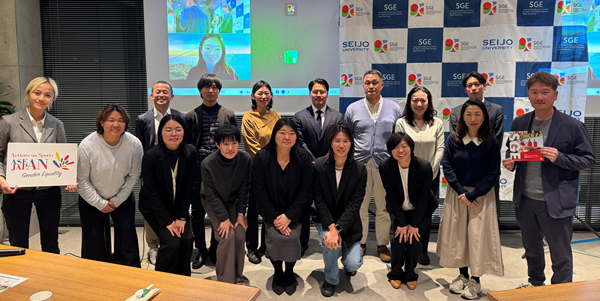
The International Research Center for Sport and Gender Equality (SGE) at Seijo University organized the 2nd Study Session on Sport × Gender × International Cooperation, inviting stakeholders engaged in international sport cooperation in Japan. The session aimed to facilitate the sharing of knowledge on sport and international cooperation - particularly in promoting gender equality - and to further strengthen networks among relevant stakeholders.
Participants included representatives from government agencies, international development organizations, non-profit organizations, private companies, and academia. Through the session, participants deepened their understanding of international cooperation in sport, with a particular focus on gender equality.
Date and Time: Thursday, 22 January 2026, 18:00–19:30 (JST)
Venue: Seijo University (Hybrid format, including online participation)
Information Sharing from SGE
1. SGE’s Initiatives on Sport and Gender Equality in the ASEAN Region
(Presented by Ms. Noguchi, Deputy Director of SGE)
Ms. Noguchi, Deputy Director of SGE, introduced the initiatives that SGE has implemented in ASEAN Member States and highlighted the importance of gender equality policies in the field of sport. In addition to presenting the overall progress of the project, she provided an overview of the current status of gender equality in sport and related initiatives undertaken in each ASEAN country.
Ms. Noguchi also shared two key concepts that are central to advancing gender equality in sport: gender mainstreaming and the gender-transformative approach. With regard to gender mainstreaming, she emphasized the importance of policy processes that integrate gender perspectives across sectors, rather than promoting only formal or symbolic equality between men and women. Regarding the gender-transformative approach, she discussed the importance of addressing and transforming existing power imbalances, unequal distribution of resources, and disparities in opportunities.
In addition, Ms. Noguchi provided insights into international policy trends as well as the structure and evolution of gender norms in Southeast Asia. She further explained that effective action requires interventions at three levels: strengthening women’s agency at the individual level, transforming attitudes and relationships at the relational level, and promoting institutional change at the structural level.
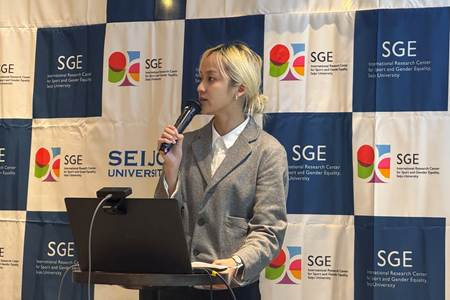
2. Research Report on Three ASEAN Countries
(Presented by SGE Postdoctoral Researcher Ms. Takada)
Ms. Takada, a postdoctoral researcher at SGE, presented the findings from field research conducted by SGE in Cambodia, Brunei, and Malaysia during fiscal year 2024.
As the theoretical framework for the study, Bronfenbrenner’s Ecological Systems Theory was applied to analyze barriers to women’s participation and sustained engagement in sport. The analysis categorized these barriers into four levels: individual, relational, organizational, and socio-cultural factors.
Regarding country-specific findings, several distinctive features were highlighted. In Cambodia, despite the persistence of strong traditional gender roles and division of labor, the 2023 SEA Games have served as a catalyst for social change through sport, including shifts in gender norms. In Brunei, although women face challenges in continuing participation in sport within a male-dominated cultural context, sport participation also shows potential to contribute to the protection of women’s rights and the expansion of their capabilities. In Malaysia, where a multi-ethnic society coexists, sport was identified as having the potential to promote mutual understanding among communities and to challenge entrenched stereotypes.
3. Sport and International Cooperation in the ASEAN Region
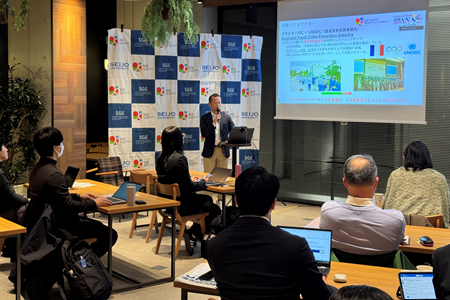
(Presented by Sho Sato, Project Manager at SGE)
Mr. Sho Sato, Project Manager of the Japan–ASEAN Programme at SGE, provided an overview of the current landscape of sport and international cooperation in the ASEAN region. His presentation introduced the key policy framework of the region, the ASEAN Work Plan on Sport, outlining its objectives and strategic priorities.
He also discussed the increasingly diverse range of actors involved in international cooperation in sport within the region. As a policy perspective, he highlighted the importance of enhancing Japan’s presence through multi-sectoral collaboration leveraging international milestones, as well as the need to consider human resource development with a view to achieving medium- and long-term diplomatic outcomes.
In particular, he noted that the initiatives previously implemented - primarily led by the Japan Sports Agency - have generated outcomes that are organically interconnected and have also contributed to the effectiveness of the ASEAN-Japan programme implemented by SGE. These initiatives have increasingly functioned as a form of Japan’s soft power in the region, and he shared perspectives on their future potential.
Comments from Participants
Japan International Cooperation Agency (JICA)
We appreciated the valuable opportunity to participate in the 2nd Study Session on Sport × Gender × International Cooperation. As practitioners engaged in international cooperation through sport, the session provided us with many insights and valuable learning opportunities.
The research knowledge accumulated by the SGE at Seijo University, together with its commitment to promoting gender mainstreaming while engaging diverse stakeholders both domestically and internationally, will play an increasingly important role in both policy and practice in the field of international cooperation.
As JICA, we also aim to further integrate perspectives on sport and gender into our initiatives, including the JICA Overseas Cooperation Volunteers programme and other sport and development projects, in order to strengthen our efforts toward building sustainable and inclusive societies.
Japan Sport Council (JSC)
The session provided a comprehensive overview of current trends in international cooperation in sport within the ASEAN region. In light of developments such as the revision of the ASEAN Work Plan on Sport and the increasing diversity of actors involved, the presentations accurately captured the growing international trend of positioning sport as a tool for addressing social challenges, offering many valuable insights.
In particular, the introduction of the Sport and Youth Crime Prevention Initiative clearly illustrated the importance of a multi-sectoral framework linking sport, justice, and diplomacy.
ASICS Foundation
We found the research presentation on barriers to women’s participation in sport in ASEAN countries extremely insightful. The findings provided valuable learning for the future activities of our foundation.
JIN Co., Ltd.
Through this study session, we were able to learn about concrete initiatives and research findings related to the promotion of sport and gender equality in the ASEAN region. The session enabled us to gain a comprehensive understanding not only of institutional frameworks in sport policy but also of the social and cultural factors that hinder women’s participation in sport.
Listening to the presentations while reflecting on our experience in the JICA Technical Cooperation Project “Peace Promotion through Sport in South Sudan”, in which our company was involved, also reaffirmed the importance of approaches that consider the specific contexts of each region.
The session also highlighted the necessity of promoting gender equality through collaboration with diverse stakeholders. These discussions provided valuable insights for the planning and implementation of sport-related international cooperation projects in the future.
We would like to express our sincere appreciation for the opportunity to participate and hope to apply the knowledge gained from this session to our future work in the field of sport and international cooperation.
International Development Center of Japan (IDCJ)
During a survey commissioned by JICA, when exchanging views with government officials in several countries, we did not observe a strong awareness of gender issues. In contrast, the findings presented in this study session suggested different perspectives. It would therefore be interesting to further explore where this gap in perception may arise.
In addition, while each presentation was allocated 15 minutes, we felt that this time was somewhat limited, as each lecture raised topics that we would have liked to explore in greater depth.
SGE will continue to create opportunities for dialogue in order to deepen practical and policy-oriented discussions in the field of sport, gender equality, and international cooperation.